当代知识分子公益讲堂系列之六十六:AI代理时代的共生主义#66 Contemporary Intellectuals Lecture: Symbioticism in the Age of AI Agents
📋 讲座信息 · Event Details
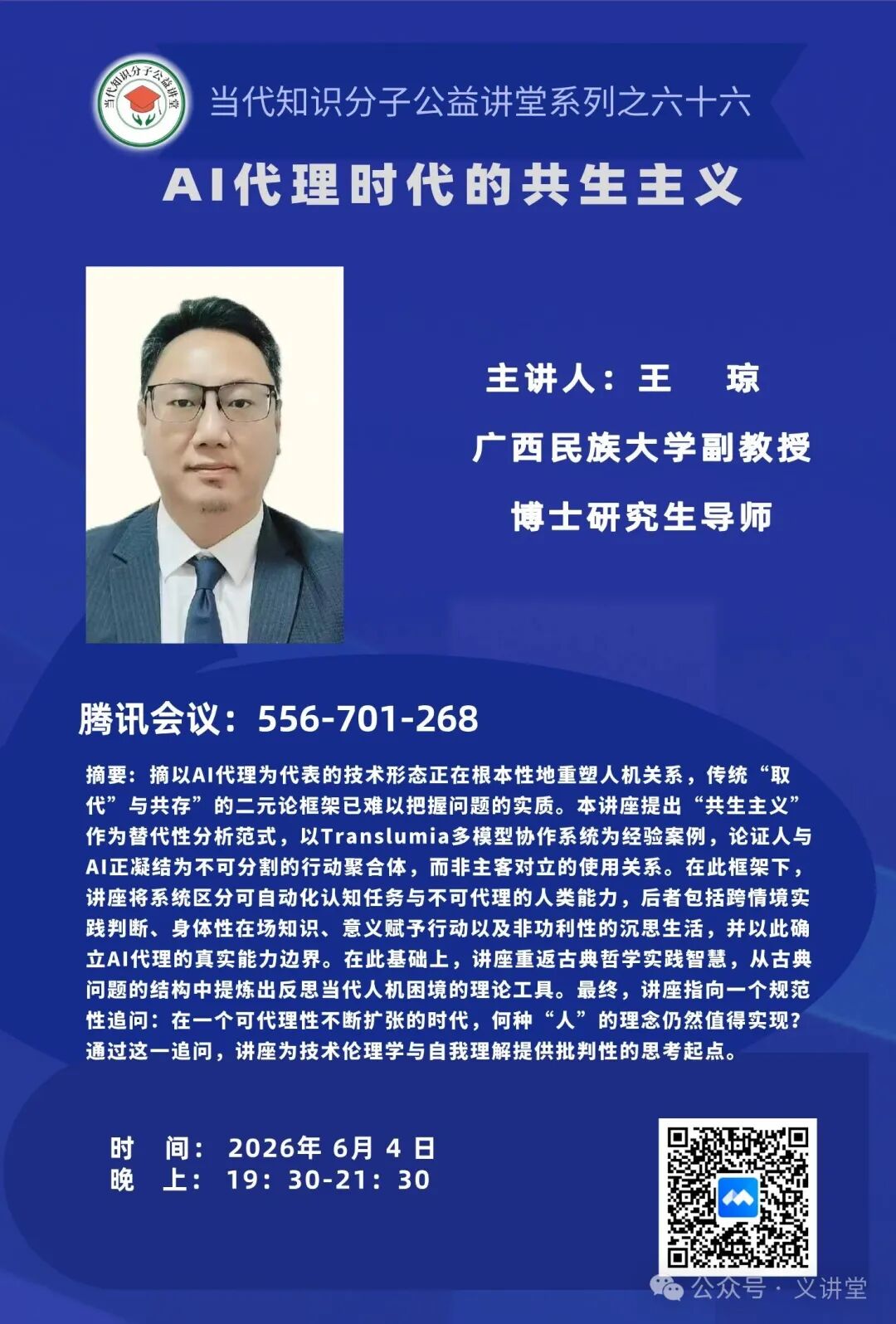
AI 代理时代的共生主义
Symbioticism in the Age of AI Agents
系列:当代知识分子公益讲堂 #66 主题:AI 代理时代的人机关系重构与共生主义理论
📅 会议信息 · Event Details
| 项 | 内容 |
|---|---|
| 🎤 主讲人 | 王 琼 副教授 · 博士研究生导师 John Qiong WANG, Associate Professor & PhD Supervisor |
| 🏛 单位 | 广西民族大学外国语学院 School of Foreign Studies, Guangxi Minzu University |
| 📆 时间 | 2026年6月4日(周四)19:30–21:30 Thursday, June 4, 2026, 19:30–21:30 (CST) |
| 📍 地点 | 腾讯会议:556-701-268 Tencent Meeting (Online) |
| 📝 主题 | AI 代理时代的共生主义 / Symbioticism in the Age of AI Agents |
📑 目录 · Table of Contents
- 讲座简介 · Abstract
- 不可代理的人类能力 · Humanese 三重向度
- 行动指南:三守三做 · Action Guide
- 中国哲学资源 · Chinese Philosophical Resources
- 结语 · Closing
- 学术参考 · Selected References
讲座简介 · Abstract
以 AI 代理为代表的技术形态正在根本性地重塑人机关系。2024 年之后,人机关系已走完四重台阶:由弱至强依次为「工具(Instrument)—协作者(Collaborator)—合作伙伴(Partner)—准主体(Quasi-subject)」。AI 已不再是按需取用的工具,而是人类生存的基础环境。这不再是「使用」,而是「共同生存」。
💡 核心命题 (Core Proposition)
传统「取代」与「共存」的二元论框架已难以把握问题的实质。本讲座提出「共生主义」(Symbioticism)作为替代性分析范式——既非「主仆」(人类绝对控制),亦非「替代」(AI 取代人类),更非「融合」(人机界限消解),而是回到中国传统「生生」哲学:两个不可相互替代的存在者,在同一关系网络中相互成就、协同演化。
以 TransLumia 多模型协作系统为经验案例,讲座将论证:人与 AI 正凝结为不可分割的行动聚合体(action assemblages),而非主客对立的使用关系。完全闭环的 AI 系统必然因信息熵单调递增而自我坍缩,人类作为「异质性」要素,是维持系统长期演化的唯一结构性方案。
AI agents and related technological forms are fundamentally reshaping the human-machine relationship. After 2024, this relationship has climbed four rungs—from Instrument to Collaborator to Partner to Quasi-subject. AI is no longer a tool invoked on demand, but the foundational environment of human existence. This is not "usage" but "co-existence."
This lecture proposes Symbioticism as an alternative analytical paradigm: neither mastery (absolute human control), nor substitution (AI replacing humans), nor fusion (dissolution of human-machine boundaries), but a return to the Chinese tradition of shengsheng (生生): two irreplaceable beings mutually actualizing and co-evolving within the same relational network.
Using the TransLumia multi-model collaborative system as an empirical case, the lecture demonstrates that humans and AI are coalescing into inseparable action assemblages rather than subject-object relations of use. Fully closed-loop AI systems inevitably self-collapse as information entropy increases monotonically; humanity as the "heterogeneous" element is the only structural solution for maintaining the system's long-term evolution.
不可代理的人类能力 · Non-Delegable Human Capacities
在此框架下,讲座系统区分可自动化认知任务与不可代理的人类能力。后者集中体现为「人蕴」(Humanese)——人类本质的不可计算性,由三重向度构成:
🔹 Humanese 三重向度 · Three Dimensions
| 向度 | 核心命题 | 哲学根基 | AI 不可企及之根源 |
|---|---|---|---|
| 本体论 Ontology | 向死而生 Being-towards-death |
Heidegger Sein-zum-Tode (1927) |
AI 无死亡焦虑,其「选择」缺乏本体论意义上的切身性 |
| 认识论 Epistemology | 感而遂通 Resonant Comprehension |
《周易》 I Ching |
AI 缺乏「先被感动」的前反思认知 |
| 伦理学 Ethics | 他者召唤 The Face of the Other |
Lévinas Totalité et Infini (1961) |
AI 不具备被「他者面容」触动并承担伦理责任的主体性 |
🔹 四类不可代理能力 · Four Non-Delegable Capacities
具体而言,不可代理的人类能力包括:
- 跨情境实践判断(Cross-contextual practical judgment)— 无法被算法化的情境感知与抉择
- 身体性在场知识(Embodied knowledge of bodily presence)— 具身认知中的不可替代维度
- 意义赋予行动(Meaning-giving action)— 价值判断与文化意义的创造
- 非功利性的沉思生活(Non-utilitarian contemplative life)— 超越工具理性的思考本身
The latter are constituted by three dimensions — Ontology: Being-towards-death (Heidegger); Epistemology: Resonant Comprehension (I Ching); Ethics: The Face of the Other (Lévinas) — and four non-delegable capacities: cross-contextual practical judgment; embodied knowledge; meaning-giving action; non-utilitarian contemplative life.
行动指南:三守三做 · Action Guide
🎯 在算法环境中,个体如何守护主体性? How does the individual safeguard subjectivity in the algorithmic environment?
讲座提出「三守三做」行动框架:
🛡️ 三守(守护 / Safeguarding)
| 守 | 英文 | 核心要义 |
|---|---|---|
| 守具身 | Guarding Embodiment | 回归身体的原初感知,将其作为抵御算法异化的最后防线 |
| 守判断 | Guarding Judgment | 警惕算法信息茧房、数字亲密关系替代与便利性成瘾 |
| 守面向 | Guarding the Three Faces | 铭记向死而生、感而遂通、他者召唤对主体的奠基意义 |
⚡ 三做(践行 / Practicing)
| 做 | 英文 | 核心要义 |
|---|---|---|
| 核心能力重塑 | Reshaping Core Competencies | 培养批判性提问、承担后果的决断力、共情与关怀 |
| 风险边界辨识 | Identifying Risk Boundaries | 明确「安全区」(具身在场、复杂决策、原创生成)与「危险区」 |
| 医疗场景具身干预 | Embodied Intervention in Medicine | 当算法数据与患者具身直觉相悖时,优先尊重主体感知 |
中国哲学资源 · Chinese Philosophical Resources
「共生主义」的理论根基,深植于中国传统哲学。讲座以四组核心隐喻作为 AI 时代的理论映射:
📜 四元互生 · Four Operators
| # | 命题 | 出处 | 英文对译 | AI 时代映射 |
|---|---|---|---|---|
| ① | 两不立则一不可见 | 张载《正蒙》 | Without the two, the one cannot be seen | 人与 AI 作为对立两极,各安其位方能确立共生关系 |
| ② | 物壮则老 | 《道德经》30 章 | When things reach their prime, they begin to decay | 警惕技术至上主义,系统鼎盛往往孕育衰颓 |
| ③ | 亢龙有悔 | 《周易·乾卦》 | The arrogant dragon will have cause to repent | AI 能力越趋向全能,人类越需保留核心否决权 |
| ④ | 孤阴不生,独阳不长 | 《周易》 | Solitary yin cannot generate, isolated yang cannot grow | 纯粹 AI 闭环必然坍缩,唯有保持两极异质性互动方能生生不息 |
The theoretical roots of Symbioticism lie deep in Chinese philosophy. The lecture deploys four classical metaphors — ① ② ③ ④ — as theoretical mappings for the AI era, drawing on Zhang Zai, the Tao Te Ching, and the I Ching.
结语 · Closing
❓ 核心追问 (Normative Question)
在一个可代理性不断扩张的时代,何种「人」的理念仍然值得实现?
In an age of expanding delegability, what conception of the "human" remains worth realizing?
讲座最终指向一个规范性追问:当 AI 能代理越来越多的认知任务,人类的主体性究竟安放在何处?共生主义给出的答案清晰而坚定:
❤️ 共生主义的核心要义 (Essence of Symbioticism)
爱、痛、关怀、判断、拒绝、原谅、犹豫、沉默与在场。
To love, to ache, to care, to judge, to refuse, to forgive, to hesitate, to remain silent, and to be present.
这些不可计算的具身性体验,构成了人类作为鲜活、必死且独一无二之主体的核心确证。
These uncomputable embodied experiences constitute the core validation of humanity as living, mortal, and utterly unique subjects.
学术参考 · Selected References
- Heidegger, M. (1927). Sein und Zeit. Tübingen: Max Niemeyer. (Being and Time)
- Lévinas, E. (1961). Totalité et Infini. The Hague: Martinus Nijhoff. (Totality and Infinity)
- 张载(北宋). 《正蒙·太和篇》. Zhang Zai (Song Dynasty). Correcting the Ignorant — Chapter on Great Harmony.
- 《周易·乾卦》 / 《道德经》第三十章 / 《中庸》第二十六章. I Ching · Qian / Tao Te Ching Ch. 30 / Zhongyong Ch. 26.
主讲人简介 / Speaker Bio
王 琼,副教授,博士研究生导师,广西民族大学外国语学院。研究领域:AI 翻译哲学、posthumanism、Deleuze 与共生主义理论体系。代表作:《The Agentic Translator and the Posthuman Condition》《共生主义框架下 AI 代理与译者主体性疆域的重构》。
John Qiong WANG, Associate Professor & PhD Supervisor at the School of Foreign Studies, Guangxi Minzu University. Research interests: philosophy of AI translation, posthumanism, Deleuze, and the theoretical system of Symbioticism.